You don’t need a bench press. You don’t need dumbbells. You don’t even need a gym membership.
A strong, defined chest is absolutely achievable with nothing but your body and ten minutes. The pushup—the world’s oldest chest exercise—is secretly one of the most effective tools for building upper body strength. When you understand the variations, the angles, and the science, your living room floor becomes a complete chest gym.
This guide delivers a complete chest workout you can do anywhere, anytime. We’ll break down every movement with step-by-step precision, explain the muscles you’re targeting, and give you progression strategies that keep you growing for months. No equipment. No excuses. Just results.
The Science: Why Bodyweight Chest Training Actually Works
Before we move, let’s address the question every beginner asks: Can I really build chest without weights?
Yes. Emphatically yes.
Your muscles don’t know whether you’re lifting a barbell or your body. They only recognize tension, fatigue, and mechanical load. A 2016 study from McMaster University found that subjects who trained with light weights (as little as 30% of their max) made equal muscle gains to those using heavy weights—provided they took sets to failure. Your bodyweight, when applied with intensity and proper form, creates that same stimulus.
Research confirms that bodyweight training can increase muscle fiber cross-sectional area in as little as eight weeks. Progressive bodyweight training produces strength gains comparable to barbell exercises. The best chest exercises don’t require a rack—they require effort.
The Warm-Up: Prepare Your Shoulders (2 Minutes)
Never skip this. Your shoulder joints need preparation before pressing movements.
Arm Circles (30 seconds): Extend arms straight out. Make small circles forward for 15 seconds and backward for 15 seconds.
Shoulder Swings (30 seconds): Swing arms forward and back gently, increasing range as you loosen up.
Cat-Cow Stretch (30 seconds): On hands and knees, alternate between rounding your spine (cat) and dropping your belly (cow). This mobilizes your entire upper back.
Push-Up Position Hold (30 seconds): Hold a perfect plank. Hands under shoulders, body straight, core braced. Feel your chest and shoulders wake up.
“A proper warm-up isn’t optional—it’s your injury prevention policy. Five minutes saved here could cost you weeks of recovery later.”
The Main Event: Your 10-Minute No-Equipment Chest Workout
This workout uses a HIIT-style timer: 40 seconds of work, 20 seconds of rest. Complete two full rounds for exactly 10 minutes. Each exercise targets your chest from a different angle, ensuring complete development of the pectoral muscles.
Set your phone timer. Let’s go.
Round 1
Exercise 1: Standard Push-Ups (40 seconds)
The foundation of every great chest workout. Master this before attempting anything fancy.
Step-by-Step Form:
- Start in a high plank position. Hands directly under shoulders, slightly wider than shoulder-width apart.
- Your body must form a straight line from head to heels. Squeeze your glutes and brace your core like you’re about to be punched.
- Lower your body until your chest nearly touches the floor. Elbows should form roughly a 45-degree angle to your body—not flared straight out.
- Press back up explosively, fully extending your arms at the top.
Muscles Worked: Pectoralis major (whole chest), anterior deltoids (front shoulders), triceps, core.
Related Post

Common Mistakes to Avoid:
- Sagging hips: This kills chest engagement and strains your lower back. Keep everything tight.
- Half reps: Lowering only an inch defeats the purpose. Chest to floor, every time.
- Flared elbows: Straight-out elbows stress shoulders. Keep them at that 45-degree angle.
Modification (Easier): Perform on your knees, keeping your body straight from shoulders to knees.
Modification (Harder): Elevate feet on a couch or chair (decline push-up).
“Turn the pits of your elbows forward during push-ups. This small rotation externally rotates your shoulders, engages your lats, and protects your joints”.
Exercise 2: Wide Push-Ups (40 seconds)
Why This Works: Widening your hand placement shifts emphasis to the outer pectoral fibers and increases overall chest activation.
Step-by-Step Form:
- Place hands significantly wider than shoulder-width apart—think 1.5 times normal width.
- Maintain that straight line from head to heels. Core tight, glutes squeezed.
- Lower your chest toward the floor. You’ll feel a deeper stretch across your chest.
- Press back up, focusing on squeezing your chest muscles at the top.
Muscles Worked: Outer pectorals, front shoulders, triceps.
Modification: The knee version works at the same angle with less load.
“Wider isn’t always better. If you feel shoulder pain, bring your hands slightly closer. Find your sweet spot.”
Rest 20 Seconds
Round 2
Exercise 3: Incline Push-Ups (40 seconds)
Hands elevated on a couch, chair, or sturdy table. Feet on floor.
Why This Works: Incline push-ups target the lower chest fibers and are slightly easier than standard push-ups—perfect for maintaining intensity when fatigue builds. They also reduce shoulder strain, making them ideal for those with sensitivity.
Step-by-Step Form:
- Place hands on elevated surface shoulder-width apart.
- Walk feet back until your body forms a straight diagonal line.
- Lower chest to the surface, keeping elbows at 45 degrees.
- Press back up smoothly.
Muscles Worked: Lower chest, shoulders, triceps.
Progression: The lower the surface (coffee table vs. countertop), the harder the exercise.
Exercise 4: Diamond Push-Ups (40 seconds)
Hands together forming a diamond shape beneath your chest.
Why This Works: Narrow hand placement dramatically increases triceps activation while targeting the upper chest and inner chest fibers. This is where the “chest sweep” comes from.
Step-by-Step Form:
- Place thumbs and index fingers together to form a diamond directly under your chest.
- Elbows will naturally point backward—that’s correct.
- Lower your chest toward your hands. Keep your body straight.
- Press up, feeling the burn in both chest and triceps.
Muscles Worked: Upper chest, inner chest, triceps.
Modification: If this is too challenging, perform on knees or widen hands slightly into a narrow push-up.
“Diamond push-ups are brutally effective but equally brutal on wrists. If wrists hurt, make fists and do knuckle push-ups with hands together instead.”
Rest 20 Seconds
Round 3
Exercise 5: Decline Push-Ups (40 seconds)
Feet elevated on couch or chair, hands on floor.
Why This Works: Decline push-ups are the bodyweight equivalent of incline bench presses—they place a greater load on the upper chest (clavicular head), an area often underdeveloped in bodyweight training. They’re also significantly harder than standard push-ups.
Step-by-Step Form:
- Place feet on elevated surface (couch, chair, bed).
- Walk hands forward until your body forms a straight line, head lowest, feet highest.
- Lower chest to floor with control.
- Press back up powerfully.
Muscles Worked: Upper chest, shoulders, triceps.
Modification: Reduce elevation height or perform on knees until strength builds.
“The steeper the decline (higher feet), the more upper chest activation. Start with low elevation and increase as you get stronger”.
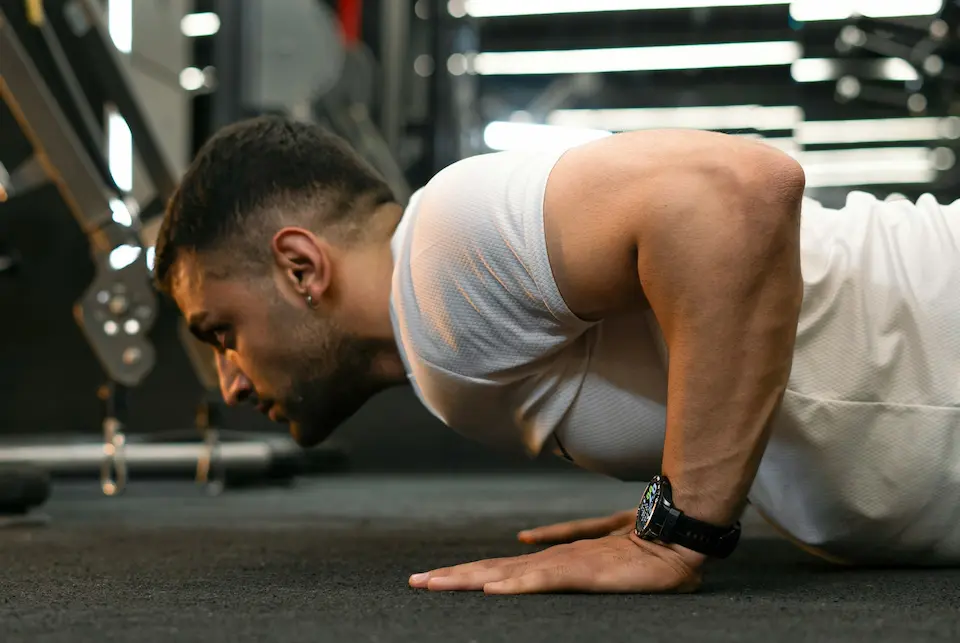
Exercise 6: Push-Up Hold + Slow Negative (40 seconds)
This is your finisher. It builds time-under-tension and exposes any form weaknesses.
Step-by-Step Form:
- Lower halfway down and hold for 10 seconds (or as long as possible within the 40-second window).
- Then descend slowly over 5 seconds until chest touches floor.
- Press back up (or reset from knees) and repeat if time remains.
Why This Works: Removing momentum and adding pauses forces your muscles to work harder without adding weight. It’s a hypertrophy secret weapon.
Muscles Worked: Entire chest, core (which must brace during the hold).
“If you can’t hold halfway, hold at the bottom. If you can’t hold at all, just do the slowest negatives you can manage. Tempo is your friend.”
Round 2: Repeat All 6 Exercises
Yes, you go through the entire circuit twice. That’s your 10 minutes. By the end, your chest should feel pumped, fatigued, and thoroughly worked.
The Cool-Down: Stretch and Recover (2 Minutes)
Chest Stretch (30 seconds each side): Find a wall or doorframe. Place your forearm against it, elbow at shoulder height. Gently rotate your body away until you feel a stretch across your chest. Hold for 30 seconds, switch sides.
Child’s Pose (60 seconds): Kneel, sit back on heels, and fold forward, resting forehead on floor. Arms extended forward or alongside body. Breathe deeply.
Triceps Stretch (30 seconds each side): Reach one arm overhead, bend elbow, and gently pull the elbow with opposite hand.
How This Workout Builds Your Chest: The Anatomy Lesson
Understanding what you’re working helps you work it better.
Your chest consists primarily of the pectoralis major—a large, fan-shaped muscle with two distinct heads:
- Clavicular head (upper chest): Activated by decline push-ups (feet elevated) and narrow hand positions.
- Sternal head (mid and lower chest): Activated by flat/incline push-ups (hands elevated) and wider hand positions.
The pectoralis minor lies underneath, helping stabilize your shoulder blades during pressing movements.
By varying your hand position and body angle across this 10-minute chest workout, you ensure complete development of all chest fibers.
The Secret to Progress: How to Keep Growing
Bodyweight training has one challenge: progressive overload. You can’t simply add plates. But you absolutely can keep progressing. Here’s how.
1. Increase Reps Within the Time Frame
Can’t do 40 seconds straight yet? That’s fine. Do as many as you can, rest in push-up position, then continue. Aim to reduce those rests over weeks.
2. Slow Down the Tempo
A 3-second lowering phase (eccentric) makes any push-up significantly harder. Try it: lower for 3 seconds, pause, explode up.
3. Add Pauses
Pause for 2 seconds at the bottom (deepest stretch) of each rep. This eliminates momentum and increases time-under-tension.
4. Elevate Your Feet
Higher feet = more weight on your hands = harder chest workout. Progress from floor to low couch to high couch.
5. Add a Backpack
Throw books or water bottles in a backpack and wear it during your workout. Instant adjustable resistance.
6. Use Unilateral Variations
Once standard push-ups feel easy, try archer push-ups or one-arm push-ups. These force one chest to handle most of your bodyweight.

“Progressive overload isn’t just about more weight. More reps, slower tempo, shorter rest, and harder variations all count as progress. Track them all”.
Sample Weekly Schedule
For best results, train chest 2-3 times weekly with at least 48 hours between sessions.
Option A (Beginner):
- Monday: This 10-minute workout
- Wednesday: Rest or light cardio
- Friday: This 10-minute workout
- Weekend: Active recovery (walking, stretching)
Option B (Intermediate):
- Monday: This workout + 5 minutes of dips (use couch)
- Wednesday: Full-body training (add pulling exercises like rows)
- Friday: This workout with advanced variations
Related Post

Option C (Time-Crunched):
- Monday, Wednesday, Friday: This exact workout
- Tuesday, Thursday: 10-minute walk
- Weekends: Rest
Beyond Chest: Why You Need Pulling Exercises Too
A warning from the science: training chest without balancing it with back work invites shoulder problems. Your chest pulls your shoulders forward; your back pulls them back. Imbalance leads to poor posture and injury.
Add these simple bodyweight pulling exercises on alternate days:
- Doorframe rows (find a sturdy door, grip edges, lean back, pull yourself forward)
- Table rows (lie under a sturdy table, grip edge, pull chest to table)
- Superman holds (lie face down, lift arms and legs, hold)
“For every pushing exercise, do a pulling exercise. Your shoulders will thank you decades from now.”
Frequently Asked Questions
The Takeaway: Consistency Beats Complexity
You don’t need a gym. You don’t need equipment. You don’t need hours.
You require ten minutes, a small patch of floor, and the willingness to push yourself.
This chest workout works because it’s built on science: varied angles for complete muscle development, timed intervals for intensity, and progressive overload pathways for continued growth. The best chest exercises aren’t complicated—they’re consistent.
Start today. Set your timer. Feel your chest work. Then do it again in two days. And two days after that.
Six months from now, you’ll look in the mirror and realize: you built that. With nothing but your body and ten minutes.
Now drop and give me six… rounds.